Insights
The dashboard showed the leak. Claude built the call list.
Use each tool for what it is good at. One shows where the money went. The other does the next job.
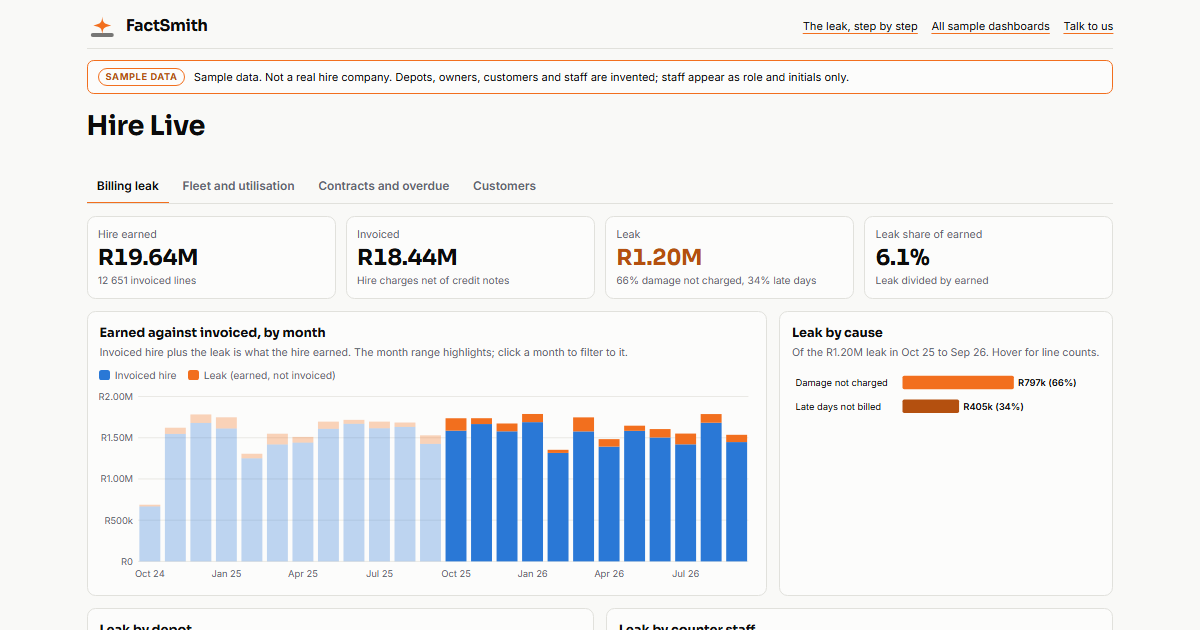
Take a small-equipment hire business with a handful of depots. In the last twelve months its tools earned R19.6M of hire. It invoiced R18.4M. The gap, R1.2M, is about 6% of revenue: R0.80M of damage the workshop repaired and nobody charged for, and R0.40M of late days billed as if the tool came back on time.
We built two things on the same warehouse to find it. A dashboard, and a conversation with Claude. They are good at different things, and the useful part is seeing which is which.
The dashboard: where
Hire Live is the interactive dashboard: four tabs (billing leak, fleet and utilisation, contracts and overdue, customers) and five slicers (franchisee, depot, category, customer segment, months). Click Cape Town and every chart follows; click the counter employee who tops the list and you are down to that person's contracts and customers.
The same numbers are also laid out as a story, the leak, step by step: to one depot (Cape Town), to one counter employee there, and to eight regular customers. Thirty cents of every leaked rand traces back to that one depot, one counter and eight customers.
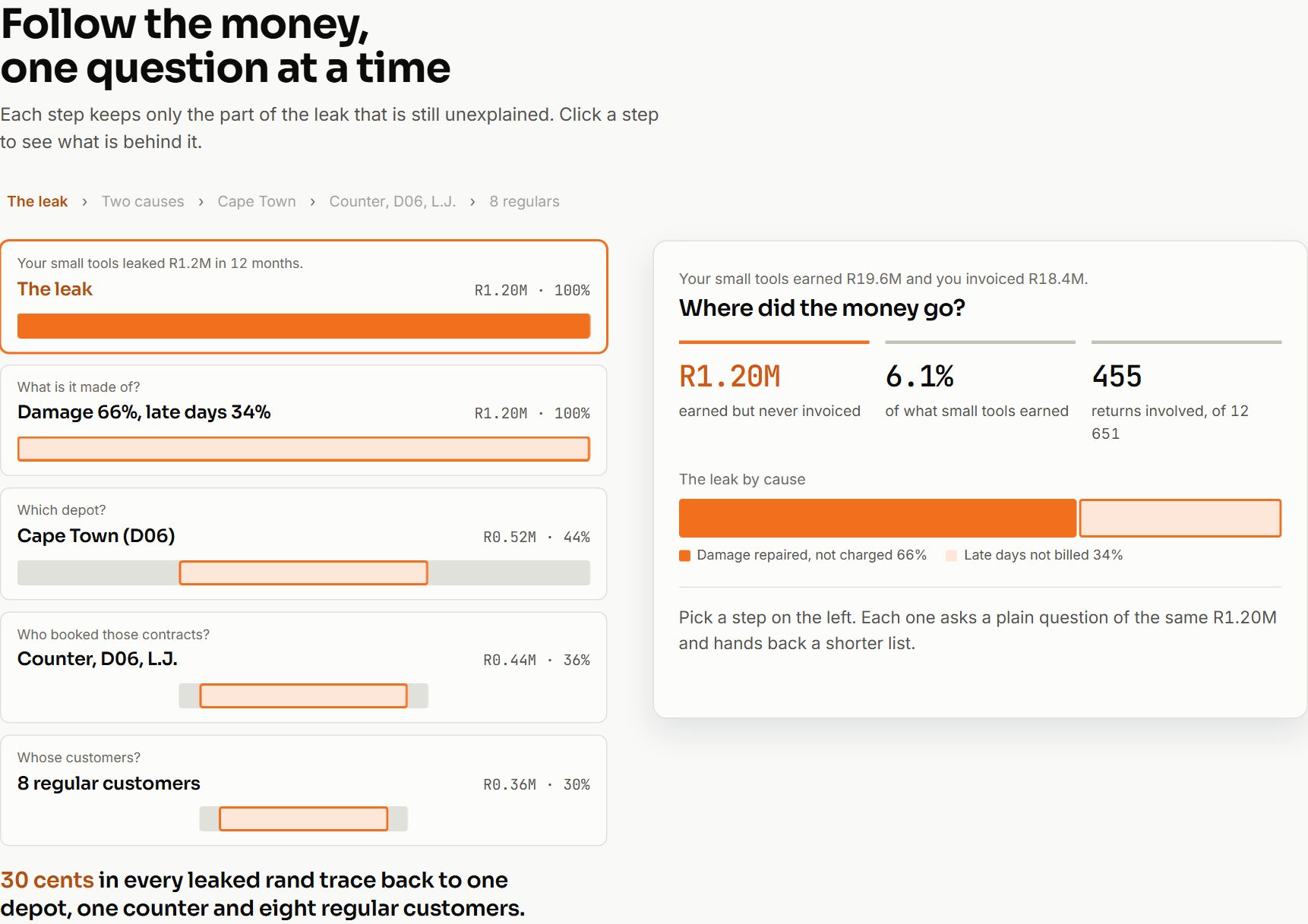
That is what a dashboard is for. The definitions are fixed and checked once, the page opens in a second, and anyone in the business reads the same numbers. What it cannot do is the next thing: it has no chart for which of these contracts can I still bill?
Claude: what next
So we opened Claude, connected it to the same data in BigQuery, and asked plain questions, one after another. One take, no rehearsed answers. The captions in the movie follow what it said.
Are we invoicing everything we should be?
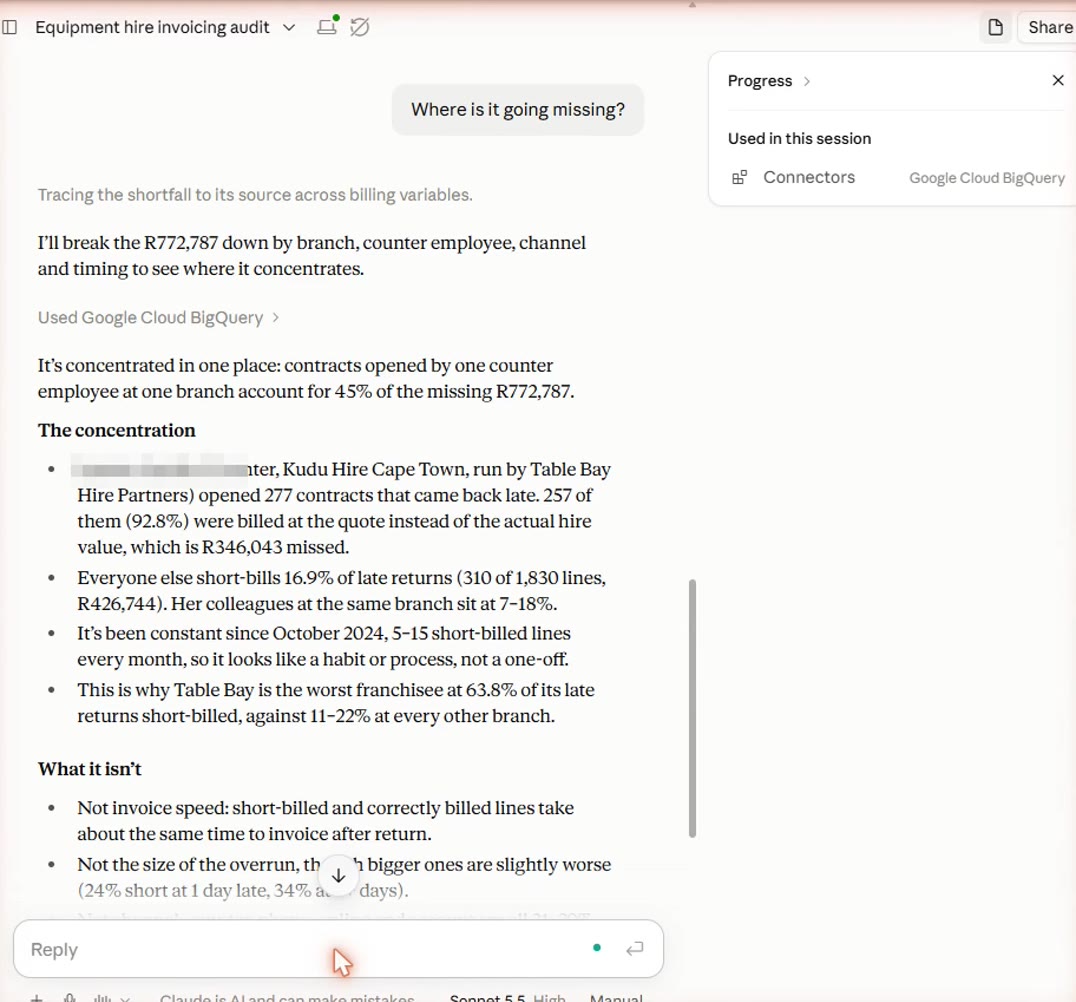
Over two years, R773k of late returns were billed at the quoted amount instead of the actual hire.Where is it going missing?
One counter employee at the Cape Town depot: 257 of 277 late contracts they opened were short-billed, 93%. Colleagues at the same depot sit at 7 to 18%.Who are their customers?
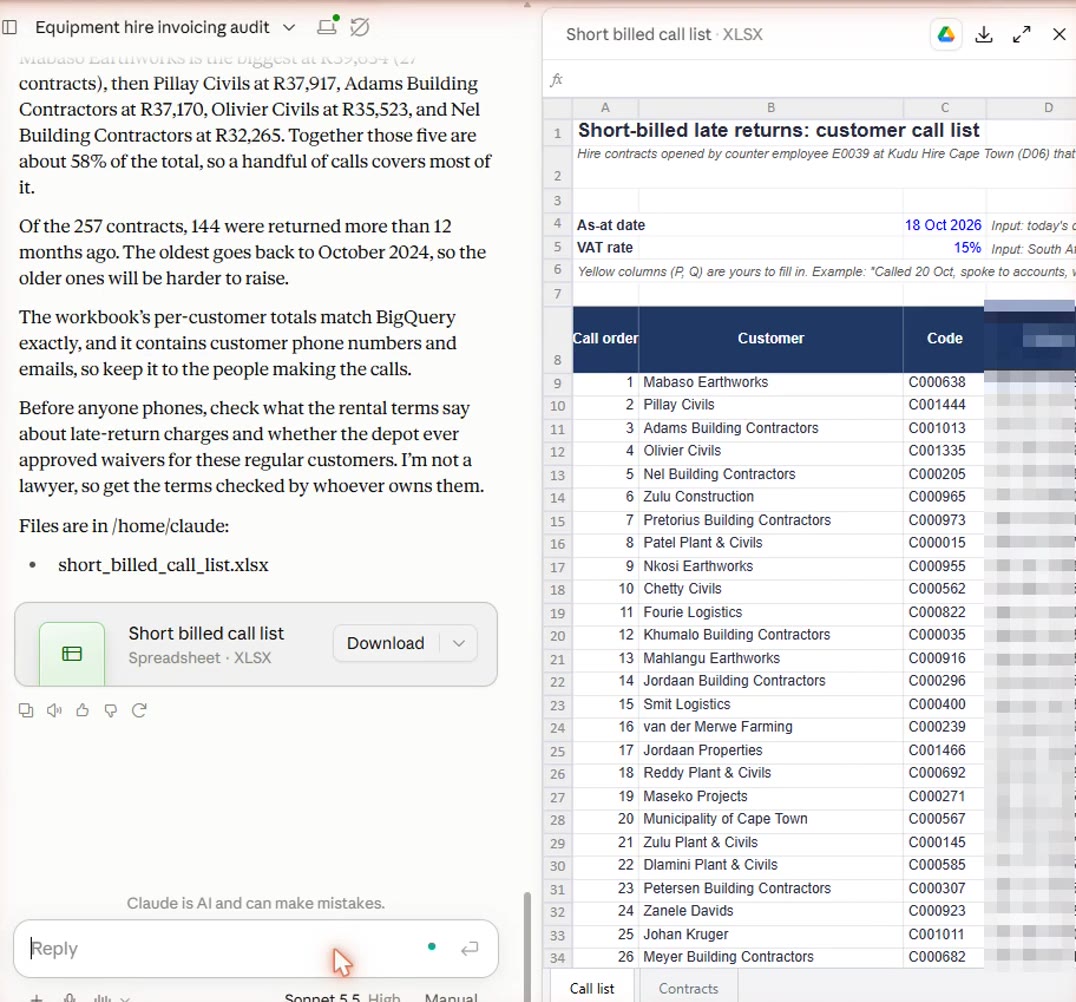
35 customers, and nine of them make up about 85% of what was missed there.Which of their contracts can we still bill? Total it per customer so I can phone each one.
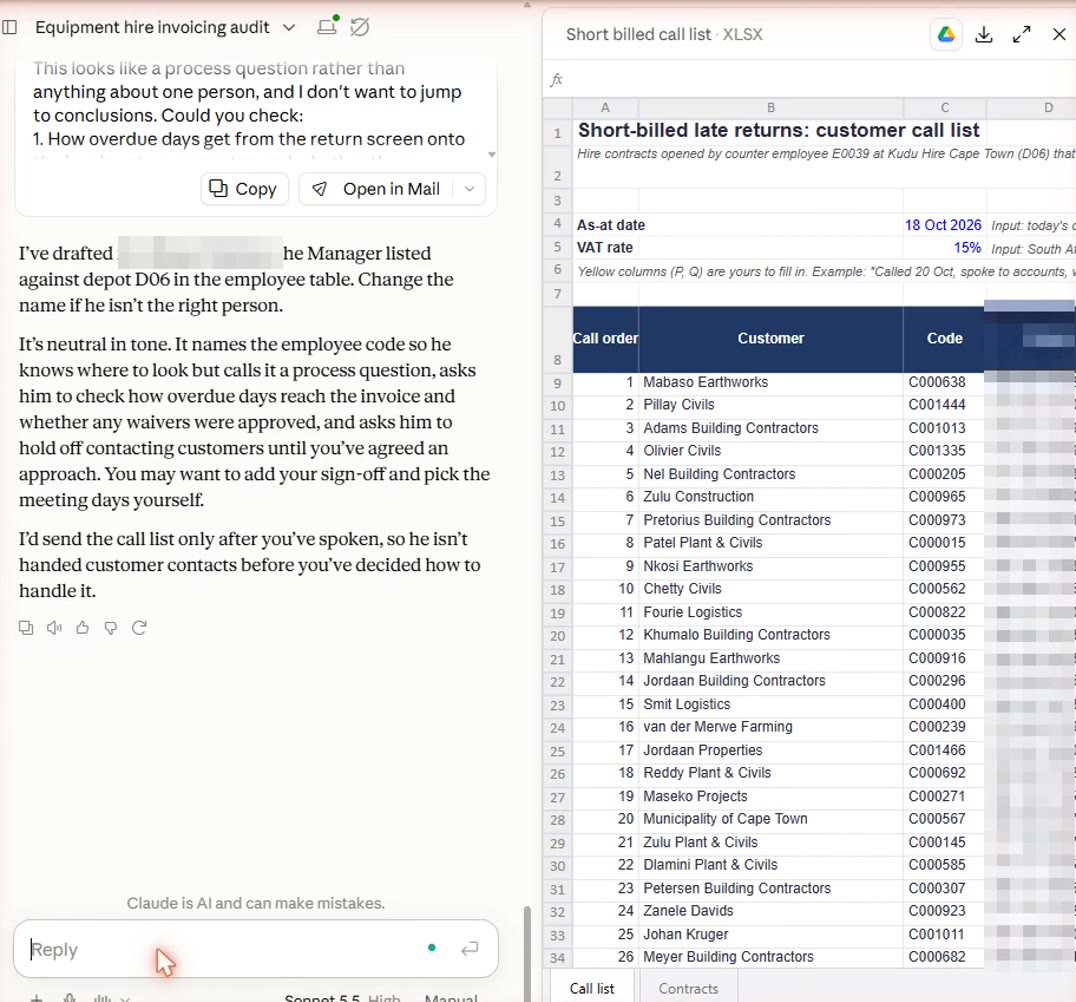
A spreadsheet: one row per customer, sorted by amount, with phone numbers.Write a short note to that depot manager.
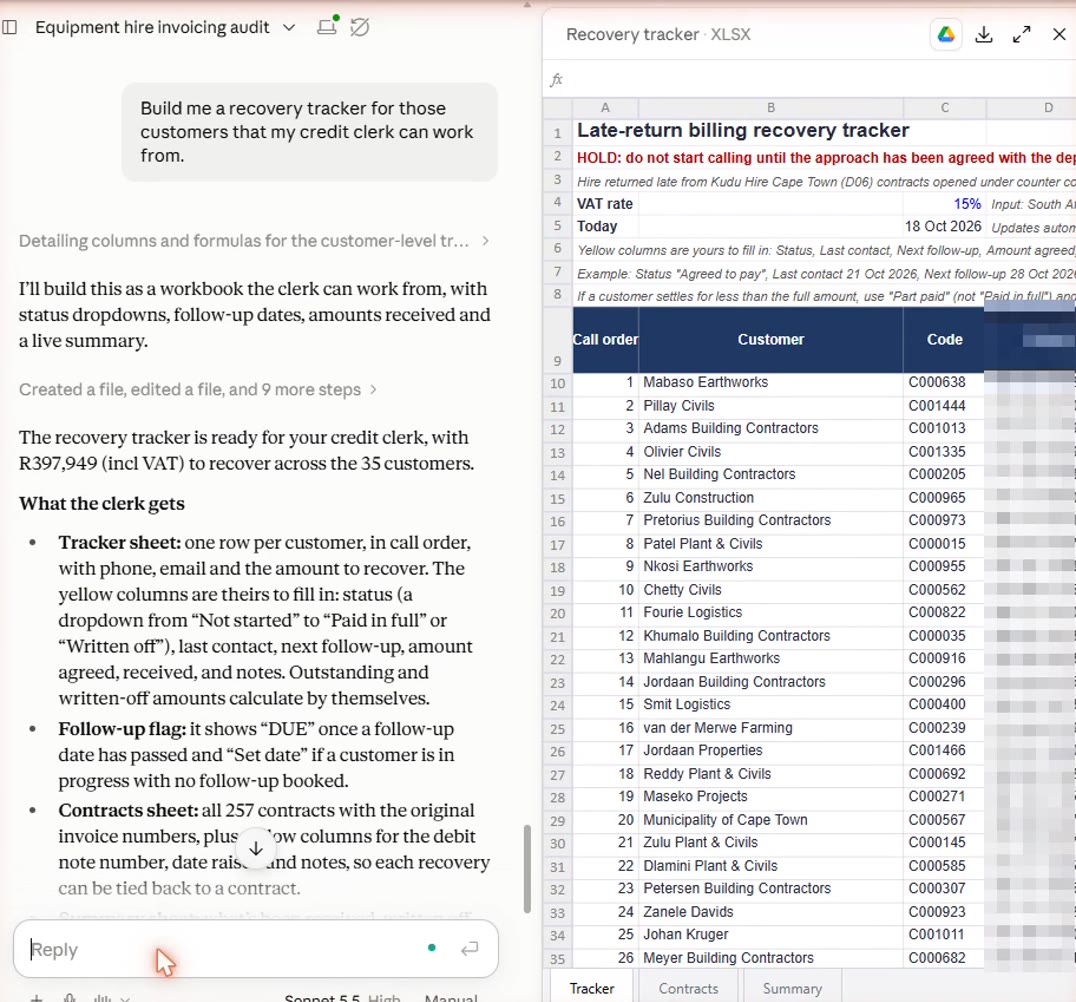
A neutral note that treats it as a process question, not an accusation.Build me a recovery tracker for those customers that my credit clerk can work from.
A workbook with status dropdowns, follow-up dates and amounts received.
Side by side
The dashboard
- The same answer every time, from definitions checked once
- Opens instantly, and anyone can read it
- Shows where the money went
- Stops at the questions it was built for
Claude on the same data
- Takes the next question in plain words
- Builds the thing you need: a list, a note, a tracker
- Chooses its own definitions, so read what it says it did
- Each answer takes a minute or two, not a second
Where they disagree
They do not land on the same number, and that is worth knowing. The dashboard counts twelve months of small equipment and both causes of the leak. Claude, asked are we invoicing everything?
, chose its own test: did the invoice match the actual days on hire? It looked at two years and every category, and found the late-return part. It never went looking for damage that was repaired but not recharged, which is the larger part.
Where they overlap, they agree: the same depot, the same counter, the same regular customers. That is because both read one modelled warehouse, with the same customers, contracts and invoices underneath. The dashboard pins the definition. Claude moves fast but picks its own. Use the first to know where to look, and the second to do something about it.
The part that makes both work
Neither tool works on raw exports. Both need the contracts, invoices, assets and customers joined up and named the same way, once. That is the work we do: get the data organised, then let you just ask.
Want to see this on your own numbers? Book a 20-minute data check, or open Hire Live and filter it to Cape Town yourself.
Sample data: a generated hire warehouse, not a real company. The chat ran in Claude (Sonnet 5.5) with Memory off, on 18 October 2026. More insights · factsmith.co.za · hello@factsmith.co.za